







Knee IKDC improvement
International Knee Documentation Committee score
ChondroFiller® has a published evidence base across knee, hip, ankle and small-joint applications. Below: what the evidence shows, what the headline outcome numbers mean, and what the evidence cannot tell you.
Treatment with Professor Paul YF Lee · 66 Harley Street, London

Published clinical evidence supports ChondroFiller® for focal cartilage defects in the knee, hip, ankle and small joints. Headline outcomes include +30 IKDC scores in knees, +33 Harris Hip Score in hips, and MOCART MRI regeneration scores of 70 to 87. Over 19,000 ChondroFiller® cases have been performed globally. Outcomes vary by defect size, location, surrounding cartilage quality and patient suitability; the evidence base continues to grow.
Watch: The Mechanism
A short manufacturer video of the keyhole technique ChondroFiller® was designed for, in which the collagen scaffold is placed into a cartilage defect, and of how the body’s own cells migrate in to rebuild tissue. Our injection delivers the same collagen to coat worn cartilage surfaces. The figures below sit on top of this biology.
ChondroFiller® is a registered trademark of Meidrix Biomedicals GmbH.
Headline Outcomes
The numbers below come from published peer-reviewed clinical studies on ChondroFiller® across multiple international centres. Individual outcomes vary.
International Knee Documentation Committee score
Harris Hip Score, post-treatment vs baseline
Magnetic Resonance Observation of Cartilage Repair Tissue
Total ChondroFiller® procedures performed worldwide
Reading the numbers
| Measure | Published result | How to interpret it |
|---|---|---|
| Knee IKDC improvement | Published result+30 pts. International Knee Documentation Committee score. | How to interpret itIKDC improvements of +30 points are typical in suitable patients. The headline IKDC, Harris Hip Score and MOCART numbers come from cohorts of patients with contained focal defects and stable joint mechanics. |
| Hip Harris Score improvement | Published result+33 pts. Harris Hip Score, post-treatment vs baseline. | How to interpret itHarris Hip Score improvements of +33 points have been reported in studied patients. The headline IKDC, Harris Hip Score and MOCART numbers come from cohorts of patients with contained focal defects and stable joint mechanics. |
| MOCART MRI regeneration score | Published result70–87. Magnetic Resonance Observation of Cartilage Repair Tissue. | How to interpret itA regenerative scaffold takes six to twelve months for new tissue to establish meaningfully. Published MOCART MRI scores improve over the same period, reflecting cartilage that is laying down rather than disappearing. |
| Diffuse surface wear, or more advanced degeneration | Published resultThe injection itself has no defect-size or age limit. | How to interpret itFor patients with diffuse surface wear or in joints with more advanced degeneration, the meaningful measure is symptom improvement and delay of replacement rather than the published focal-defect cohort scores. |
| Global ChondroFiller® cases | Published result19,000+. Total ChondroFiller® procedures performed worldwide. | How to interpret itSafety data from over 19,000 global cases supports a low rate of complications across joint applications. As with any joint injection, sterile technique and clinical follow-up are essential. |
| Long-term durability | Published resultRegenerated cartilage is biological tissue; once it is laid down, it persists. | How to interpret itBut long-term follow-up beyond five to ten years is still being collected across international centres. We tell patients honestly what the evidence does and does not yet show. |
| Real-world London Cartilage Clinic data | Published resultThe real-world series is in preparation for publication. | How to interpret itThe clinic-specific real-world series is being prepared for publication and will sit alongside the existing international evidence on this page when ready. |
| Your own result | Published resultIndividual outcomes vary. | How to interpret itNo regenerative product can guarantee a specific result. Patient biology, comorbidities, activity demands and rehabilitation all influence the outcome. |
Evidence Coverage
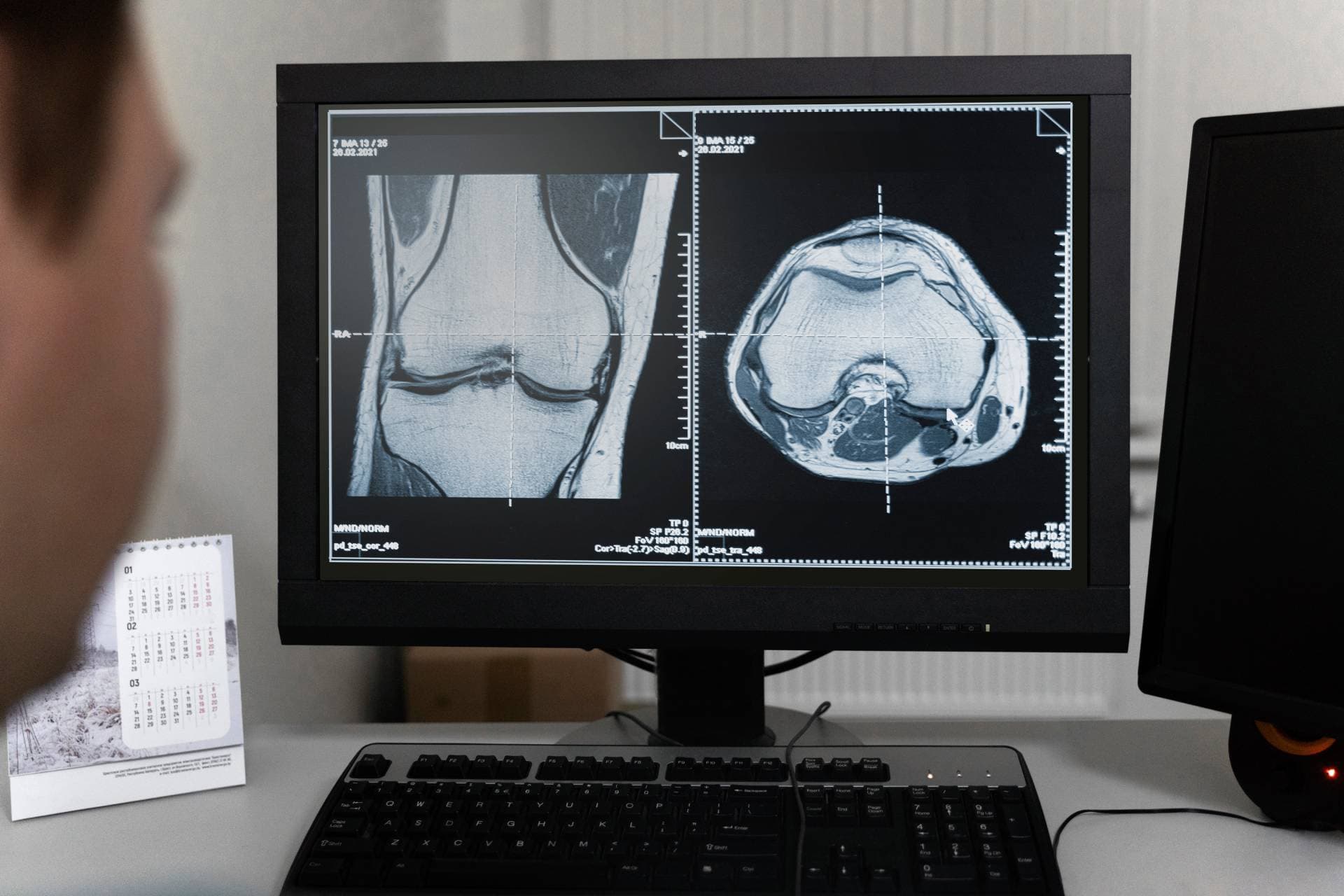
ChondroFiller® has been studied across multiple joints and clinical contexts. The evidence base is most mature in the knee but extends meaningfully across the hip, ankle and smaller joints.
Knee

Hip
Mechanism
Evidence supports ChondroFiller® use in ankle cartilage lesions, including focal chondral damage from sports injuries and osteochondral lesions of the talus.
Published case-series in thumb carpometacarpal (CMC) arthritis and wrist cartilage reconstruction including distal radius fractures with intra-articular involvement.
Safety data from over 19,000 global cases supports a low rate of complications across joint applications. As with any joint injection, sterile technique and clinical follow-up are essential.
What This Means For You
The published evidence supports ChondroFiller® for selected focal cartilage defects. It does not mean every patient with cartilage damage is a candidate, and it does not promise the same headline outcome for every individual.
Evidence is not a guarantee. A regenerative product cannot guarantee regeneration for any specific patient. Imaging review and clinical assessment at consultation are what tell us how close your case sits to the studied patient profile.
The IKDC, Harris Hip Score and MOCART improvements above come from cohorts of patients with contained focal defects and stable joint mechanics. The injection is also appropriate, with no defect-size or age limit, for patients with diffuse surface wear or for those in their 60s, 70s and beyond pursuing joint preservation, where outcomes are most meaningfully measured by symptom improvement and delay of replacement rather than against the focal-defect cohort numbers. Untreated mechanical instability is the consistent factor that undermines outcomes. See the ChondroFiller® suitability page for the patient-selection framework.
Unlike a hydrogel acting on the joint lining that can offer symptom relief in days to weeks, a regenerative scaffold takes six to twelve months for new tissue to establish meaningfully. Most patients begin to notice improvement at six to twelve weeks, with continued benefit building.
London Cartilage Clinic maintains an outcome database of all our ChondroFiller® patients. The clinic-specific real-world series is being prepared for publication and will sit alongside the existing international evidence on this page when ready.
Peer-Reviewed Research
Twelve peer-reviewed papers covering animal models, cell-free mechanism, knee, hip, ankle, hand, wrist, and safety across applications. Download any of the papers below.
Honest Caveats
ChondroFiller® has been available for over a decade in Europe, with a growing body of peer-reviewed work. As an injection in the UK it is comparatively new (London Cartilage Clinic was the first to offer it this way). Our own real-world series is in preparation for publication.
The headline IKDC, Harris Hip Score and MOCART numbers come from cohorts of patients with contained focal defects and stable joint mechanics. The injection itself has no defect-size or age limit; for patients with diffuse surface wear or in joints with more advanced degeneration, the meaningful measure is symptom improvement and delay of replacement rather than the published focal-defect cohort scores.
Regenerated cartilage is biological tissue; once it is laid down, it persists. But long-term follow-up beyond five to ten years is still being collected across international centres. We tell patients honestly what the evidence does and does not yet show.
ChondroFiller® is for focal defects in an otherwise preserved joint. Where the joint surface has been substantially lost across a wide area, joint replacement may still be the right answer. The evidence supports preservation in selected cases, not universal avoidance of surgery.
Regeneration depends on the body’s own cells migrating into the scaffold and laying down hyaline-like tissue. Patient biology, comorbidities, activity demands and rehabilitation all influence the outcome. No regenerative product can guarantee a specific result.
Evidence Into Decision
Suitability for ChondroFiller® depends on defect size, location, surrounding cartilage and joint mechanics. The published evidence applies most strongly to selected focal defects, not to every cartilage problem. Start with imaging review and a free discovery call.
Yes, in suitable patients. ChondroFiller® is an acellular collagen scaffold; the body’s own cells migrate into the scaffold and build hyaline-like cartilage in the defect over the following months. Published outcome data shows +30 IKDC scores in knees, +33 Harris Hip Score in hips, and MOCART MRI regeneration scores of 70 to 87. Outcomes depend on defect size, location, surrounding cartilage quality and patient biology.
ChondroFiller® is a regenerative scaffold, not an immediate pain-relief injection. Most patients begin to notice improvement at six to twelve weeks, with continued benefit building over six to twelve months as new tissue establishes within the scaffold. Published MOCART MRI scores improve over the same period, reflecting cartilage that is laying down rather than disappearing.
Once the scaffold has been populated by the body’s own cells and new cartilage has laid down, the regenerated tissue is biological and persists. ChondroFiller® aims to preserve the joint rather than mask symptoms, so the duration question is less about “how long does the product last” and more about “how durable is the cartilage that grows.” Outcomes vary; we follow up at six weeks and discuss longer term follow-up at consultation.
ChondroFiller® works for cartilage wear across the spectrum, from a contained focal defect to diffuse surface wear, in patients of any age. There is no upper age limit and no defect-size limit on the injection. The headline outcome studies happen to focus on contained focal defects with stable joint mechanics; patients matching that profile are most likely to match the published numbers, but the injection is also offered as a pre-replacement option for active patients in their 60s, 70s and beyond. Untreated mechanical instability is the one factor that consistently undermines outcomes. See the ChondroFiller® suitability page for the full picture.
A minority of patients do not get the expected level of regeneration. If MRI at six to twelve months does not show meaningful cartilage establishment, or symptoms persist, we re-review imaging and clinical findings. Options may include a further treatment, the Liquid Cartilage™ keyhole-surgery pathway (our proprietary technique combining ChondroFiller® with MSC co-delivery in a single arthroscopic procedure), or an alternative cartilage repair procedure. We will be honest if a different pathway is the better answer.
Yes. ChondroFiller® has a peer-reviewed evidence base across multiple international centres, covering knee, hip, ankle and small-joint applications. The published papers are listed on the ChondroFiller® hub page. Our own real-world outcome data from London Cartilage Clinic patients is in preparation for publication.
ChondroFiller® is not a substitute for knee replacement where replacement is clinically appropriate. In selected patients with focal cartilage damage in an otherwise preserved joint, ChondroFiller® may help avoid or delay knee replacement by addressing the defect before it progresses to widespread arthritis. In advanced bone-on-bone disease the aim of the injection shifts toward protecting the remaining surface and delaying replacement.
Continue exploring
Explore the other parts of your ChondroFiller decision.