








ChondroFiller® vs
Knee Replacement
ChondroFiller® is a joint-preserving scaffold for focal cartilage defects with reasonably preserved surrounding tissue. Knee replacement is definitive surgery for end-stage bone-on-bone arthritis. These usually describe different patients, but the consultation question is which one fits your case on imaging.
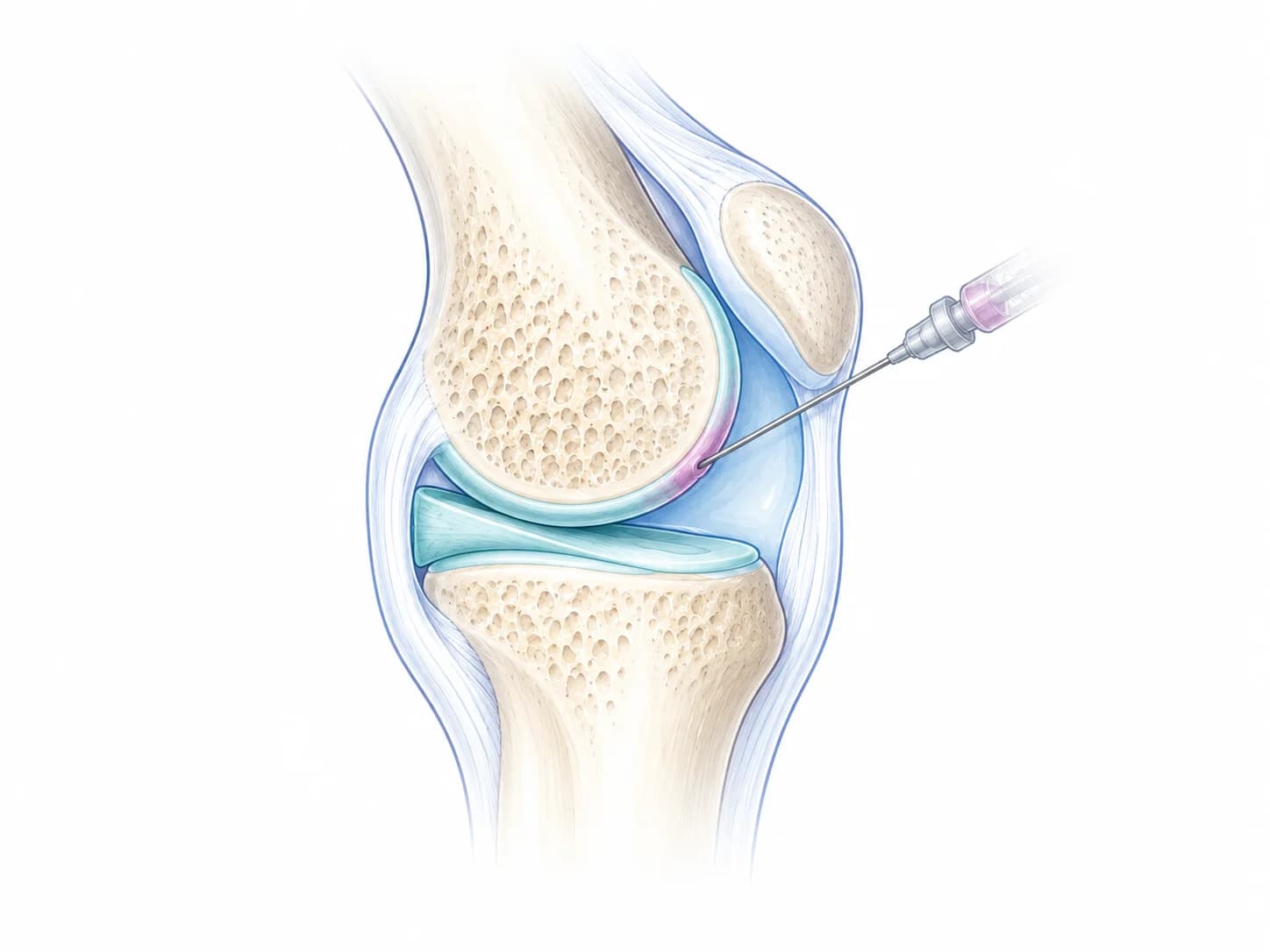
- Collagen scaffold
- Ultrasound-guided injection
- Coats the worn surface
ChondroFiller®
A collagen scaffold injected under ultrasound guidance. It sets in minutes and coats the worn cartilage so your own cells can lay down new tissue.
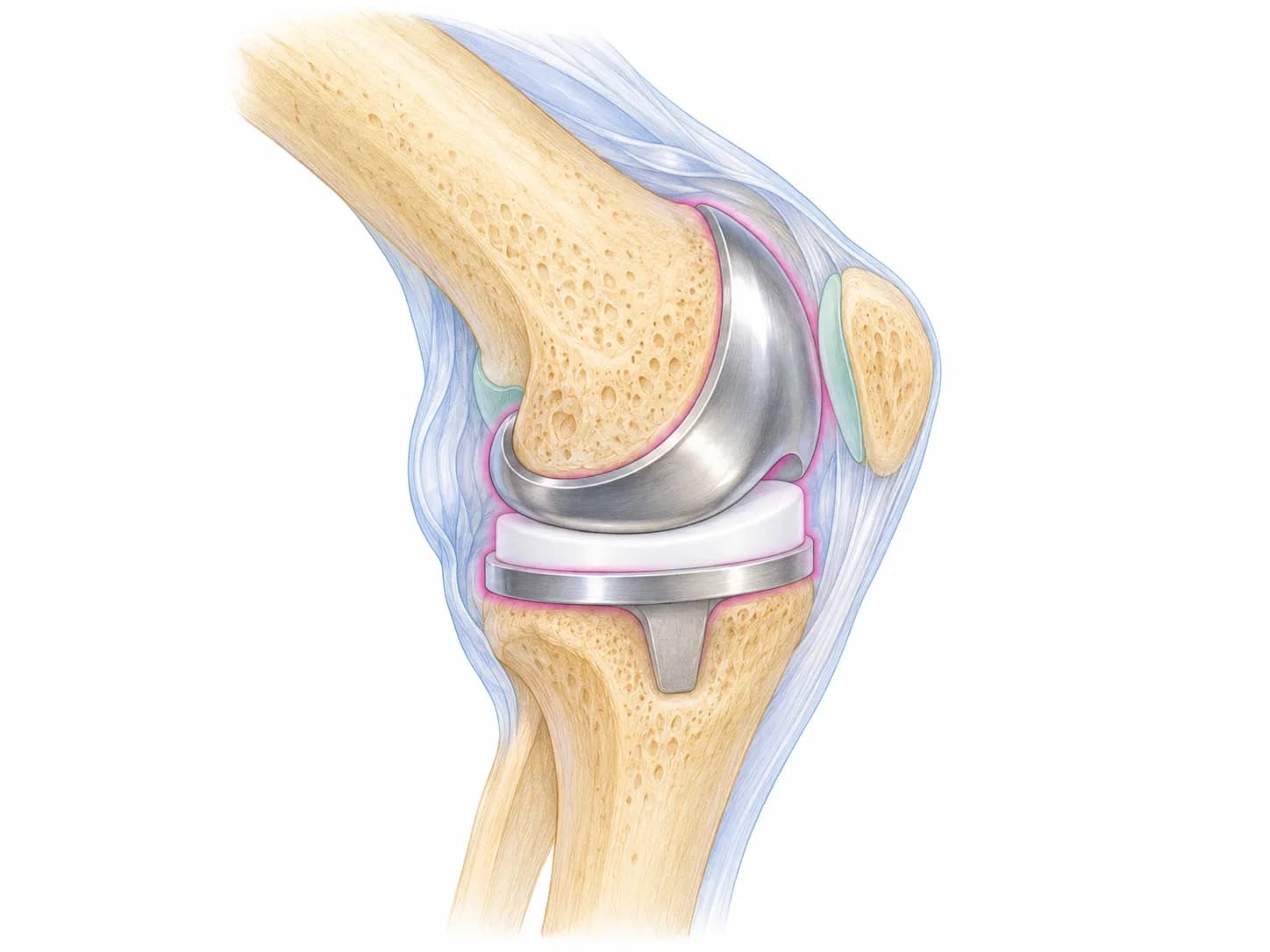
- Worn surfaces removed
- Metal components
- Polyethylene insert
Knee Replacement
Surgery that removes the worn joint surfaces and replaces them with metal and polyethylene implants.
Quick answer
ChondroFiller® is a pre-replacement option for patients who want to preserve their own joint. It is a collagen scaffold injection that coats the cartilage surface across the joint, with no upper age limit and no defect-size limit, and is particularly valuable for active patients in their 60s, 70s and beyond who have been told they need a joint replacement but want to try preservation first. Knee replacement is a definitive operation that removes and replaces the worn joint surface in end-stage arthritis. In end-stage disease where the cartilage is no longer salvageable at all, replacement remains the right answer. The choice is decided at consultation with imaging review.
How it works
ChondroFiller® vs Knee Replacement: the key difference
Knee replacement removes and replaces the worn joint surface with metal and polyethylene implants: it is a definitive, one-off operation for end-stage arthritis with a strong evidence base. ChondroFiller® is something different: a regenerative scaffold placed into a specific cartilage defect, so the body’s own cells can rebuild new tissue over six to twelve months. ChondroFiller® preserves the natural joint; replacement replaces it. They sit at very different points on the cartilage-disease ladder.
How each treatment works
ChondroFiller®
ChondroFiller® is a sterile type I collagen scaffold. At London Cartilage Clinic it is injected as a liquid into the joint under ultrasound guidance, where it sets within minutes and coats the worn cartilage at the load-bearing surfaces, from a contained focal defect to diffuse surface wear.
The patient’s own cells then migrate into the scaffold and lay down new cartilage matrix over six to twelve months. The natural joint surface is preserved: ChondroFiller® does not remove cartilage, does not drill bone and does not place an implant.
Knee Replacement
Total or partial knee replacement is a definitive surgical procedure. The worn joint surfaces are removed and replaced with metal and polyethylene implants. The underlying arthritic surface is no longer present.
Modern knee replacements have well-documented long-term outcomes. Most patients experience substantial and durable pain relief and functional improvement.
Looking ahead
What can you expect over time?
ChondroFiller®
Tissue formation over 6–12 months
Knee Replacement
15 to 20 years typically
Read the comparison in context
Your treatment plan
Number of injections
ChondroFiller®
Typically one injection course, with the box quantity (one, two or three) decided from MRI. A second ChondroFiller® course is rarely needed if the original tissue establishes; if the underlying joint then progresses to end-stage disease at a future date, replacement may become the right answer.
Knee Replacement
Knee replacement is a one-off operation. Revision surgery is sometimes needed years later in younger or higher-demand patients, but for most patients a single replacement lasts the rest of their life.
The treatment journeys
ChondroFiller® pathway
- 1
Consultation with Professor Lee
Your imaging is reviewed to judge whether the joint is still salvageable and how many boxes would be used. - 2
A short outpatient injection
Delivered under ultrasound guidance and local anaesthetic in 30 to 45 minutes, with no cartilage removed, no bone drilled and no implant placed. - 3
Home the same hour
There is no brace or crutches unless the medical team specifies otherwise, and a free telephone review follows at six weeks.
Knee Replacement pathway
- 1
Imaging and clinical review
Your clinical and imaging picture is read together to confirm that definitive surgery is the better answer. - 2
Hospital admission and surgery
The worn joint surfaces are removed and replaced with metal and polyethylene implants, with the standard peri-operative care that surgery requires. - 3
Rehabilitation over weeks to months
Recovery takes weeks to months, and for most patients a single replacement lasts the rest of their life.
Care and precautions
Understanding the risks
BEFORE · DURING · AFTER
Sterile technique.
Image guidance.
Clear aftercare.
These are very different procedures with very different risk profiles. ChondroFiller® at London Cartilage Clinic is an ultrasound-guided outpatient injection delivered under full sterile technique with routine IV antibiotic cover; the most serious risk is joint infection, which is rare.
Knee replacement is major surgery with the risks inherent in any joint replacement: infection, venous thromboembolism, anaesthetic complications, periprosthetic fracture and a rehabilitation period of weeks to months. Knee replacement is delivered through hospital admission with the standard peri-operative care that surgery requires.
Practical planning and safety
Questions to raise before either option
Ask about temporary soreness or swelling, the risk of joint infection, and anything specific to your health and current medicines. Ask who you contact if something does not feel right afterwards.
Who may suit ChondroFiller →Aftercare depends on the route
After the ChondroFiller injection there is no brace and no crutches unless your medical team specifies otherwise. Keyhole surgery follows the rehabilitation protocol set out by the manufacturer, with a brace for 48 hours and weight rebuilt over about six to eight weeks.
Read the injection aftercare guide →Your joint, your goals
Where does each option fit?

Knee replacement is the right answer for end-stage osteoarthritis: bone-on-bone change, severe deformity, persistent symptoms despite conservative measures, and a clinical and imaging picture that supports it. We will say so honestly when this is the case. ChondroFiller® is not an alternative for these patients.
ChondroFiller® is appropriate for cartilage wear in the joint, whether a contained focal defect or diffuse surface wear. There is no upper age limit and no defect-size limit on the injection. It is particularly valuable as a pre-replacement option for active patients who have been told they need a joint replacement but want to try joint preservation first. See who is suitable for ChondroFiller?
The middle ground is rarer than it sounds. Many patients who feel they are choosing between the two are clearly on one side or the other on imaging. The conversation at consultation is about reading that imaging together.
What would make the difference for you?
Questions worth taking to your consultation, so the discussion stays on your joint.
- 01What is causing my joint pain?The diagnosis and your imaging decide which treatments are worth discussing.
- 02Is there a defect, or wear across the joint?Ask how the pattern of cartilage damage shapes the recommendation.
- 03What improvement are we aiming for?Agree realistic goals for pain, function and timescale before you choose.
- 04What happens if I need more help later?Ask which options stay open if symptoms return or progress.
Planning the cost
Compare the complete care package
Ultrasound-guided injection
ChondroFiller®
From · one box
£3,000
Two boxes £5,500; three boxes £8,000. The consultation is charged separately.
Full ChondroFiller pricing →Surgery
Knee Replacement
Total knee replacement · fixed price
£18,500
At London Cartilage Clinic, ChondroFiller® costs from £3,000 for one box, £5,500 for two and £8,000 for three, with the consultation charged separately. See the ChondroFiller® cost guide.
Private knee replacement in the UK typically costs £15,000–£25,000 depending on the provider, implant type and complexity. NHS knee replacement is available for clinically appropriate cases, though waiting times vary by region.
The cost gap is real, but it is not the primary reason to choose one over the other. The more important comparison is clinical: each treatment is right for a different stage of cartilage disease.
Published London Cartilage Clinic prices. Your clinical assessment confirms the appropriate treatment and plan.
Making a recommendation
When each option may make sense
ChondroFiller®
A discussion to have
- You have a focal cartilage defect on MRI with reasonably preserved surrounding tissue.
- The joint is otherwise still salvageable and a joint-preserving regenerative pathway is a reasonable step.
- Surgery has been suggested but the imaging supports a non-surgical scaffold injection being a reasonable first step.
Knee Replacement
A discussion to have
- End-stage bone-on-bone osteoarthritis with persistent symptoms despite conservative care.
- Significant deformity, instability or mechanical failure of the joint that an injection cannot address.
- A clinical and imaging picture that points clearly to definitive surgery as the better answer.
Choosing another path
When another approach may be better
ChondroFiller®
A reason to reconsider
- Joints where imaging review points to replacement as the clinically appropriate path. Bone-on-bone wear on its own is not the deciding factor.
- Patients expecting ChondroFiller® to prevent the need for knee replacement. That is not what the treatment can promise.
- Active infection or unwillingness to accept the conservative safety protocol.
Knee Replacement
A reason to reconsider
- Focal cartilage defects in otherwise salvageable joints, where a joint-preserving regenerative procedure is the more proportionate first step.
- Significant comorbidity that makes major surgery a poor risk-benefit choice, where a less invasive option remains reasonable.
- Younger patients with a focal defect, for whom replacing the joint now creates a higher-risk revision picture in the future.
The bottom line
ChondroFiller® and knee replacement sit at very different points on the cartilage-disease ladder. ChondroFiller® is not a substitute where replacement is clinically appropriate, and replacement is overkill where a focal defect can be addressed with a joint-preserving injection. Where the joint is still salvageable, ChondroFiller® can be a reasonable step. Where the disease is end-stage, replacement is usually the right answer. We will tell you honestly which one fits your case.
Common questions
01Can ChondroFiller® help me avoid a knee replacement?
Where the joint is still salvageable, a focal cartilage defect with reasonably preserved surrounding tissue, ChondroFiller® may help preserve the joint and delay more invasive surgery. It is not a substitute where replacement is clinically appropriate, and we will not promise that it prevents the need for surgery in end-stage disease. The right answer depends on the imaging and clinical picture at consultation.
02My MRI shows bone-on-bone arthritis. Is ChondroFiller® right for me?
Not automatically. ChondroFiller® as an injection is used across the spectrum of wear, including advanced osteoarthritis, where the aim shifts toward protecting the remaining surface and delaying replacement. Where a joint is genuinely end-stage with persistent symptoms despite everything else, replacement may be the right answer and we will say so. The only way to know is a consultation with your imaging.
03Will ChondroFiller® make a future knee replacement more difficult?
Current evidence does not show that prior ChondroFiller® materially complicates a subsequent knee replacement. The scaffold integrates with the treated cartilage; the surgical field for replacement is well established. We will discuss this directly if a future replacement looks likely.
04I have been told I need a knee replacement. Should I try ChondroFiller® first?
Sometimes yes, sometimes no. Where the imaging shows a focal defect rather than diffuse end-stage arthritis, ChondroFiller® can be a reasonable step. Where the joint is genuinely end-stage with persistent symptoms, replacement may be the better answer and we will say so. Imaging review at consultation decides.
05Is ChondroFiller® available on the NHS?
ChondroFiller® is not routinely funded by the NHS in the UK at this time, and is delivered as a private treatment at London Cartilage Clinic. Knee replacement is a routine NHS procedure for clinically appropriate cases, though waiting times vary. See the ChondroFiller® cost guide for the private-pay context.
06Does ChondroFiller® regenerate cartilage or just delay surgery?
ChondroFiller® supports natural cartilage regeneration in a focal defect: the scaffold provides a structure for the patient’s own cells to form new tissue over six to twelve months. Whether that translates to delaying surgery for a given patient depends on the underlying disease and what the joint does over the following years. See the ChondroFiller® clinical evidence page for the outcome data.