








ChondroFiller® vs
MACI
MACI is the cell-based gold standard for medium-to-large knee cartilage defects: a two-stage surgical procedure backed by NICE-approved NHS use. ChondroFiller® is a single-stage scaffold injection without the cell-harvest step. Here is the honest comparison.
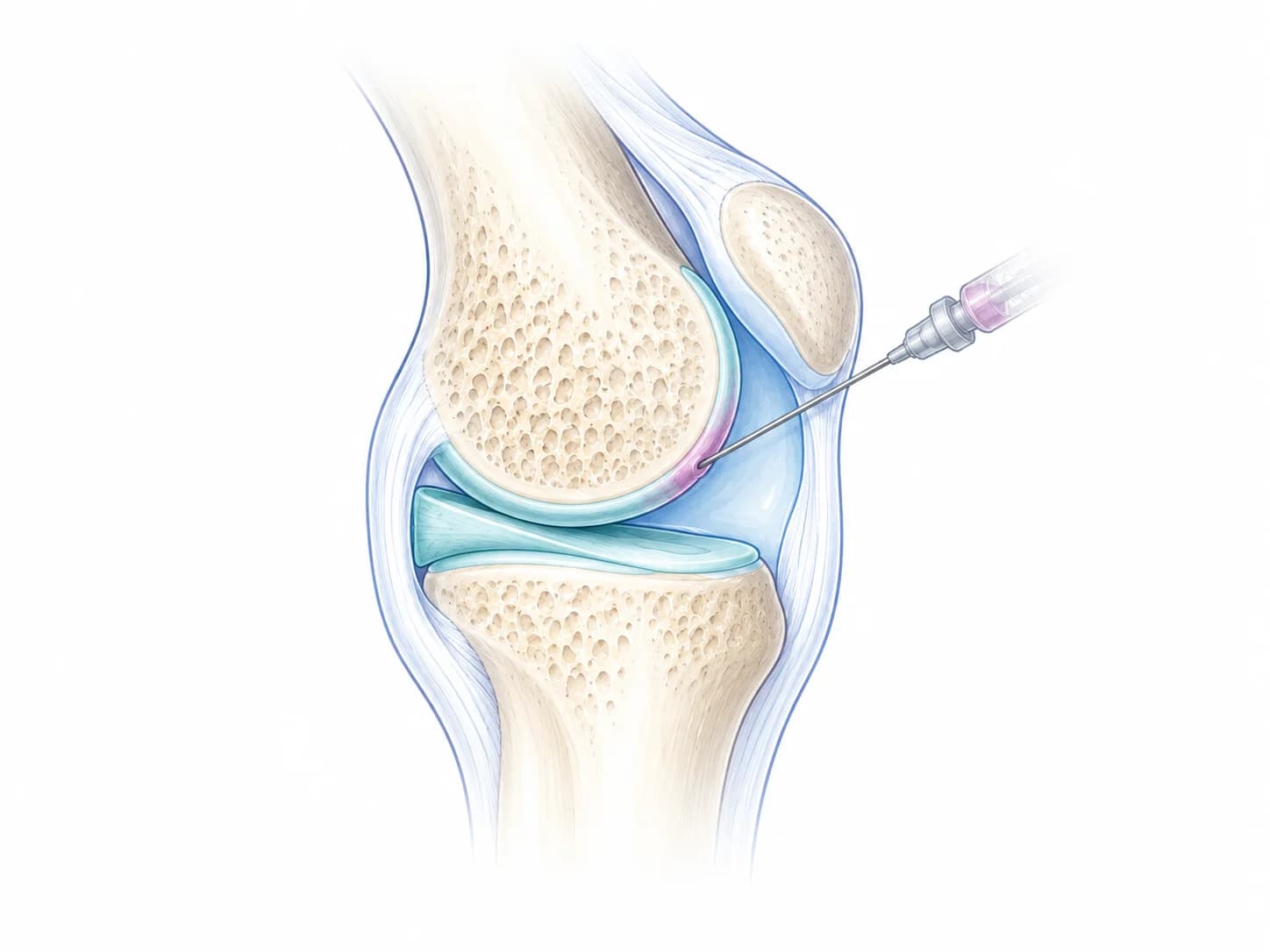
- Collagen scaffold
- Ultrasound-guided injection
- Coats the worn surface
ChondroFiller®
A collagen scaffold injected under ultrasound guidance. It sets in minutes and coats the worn cartilage so your own cells can lay down new tissue.
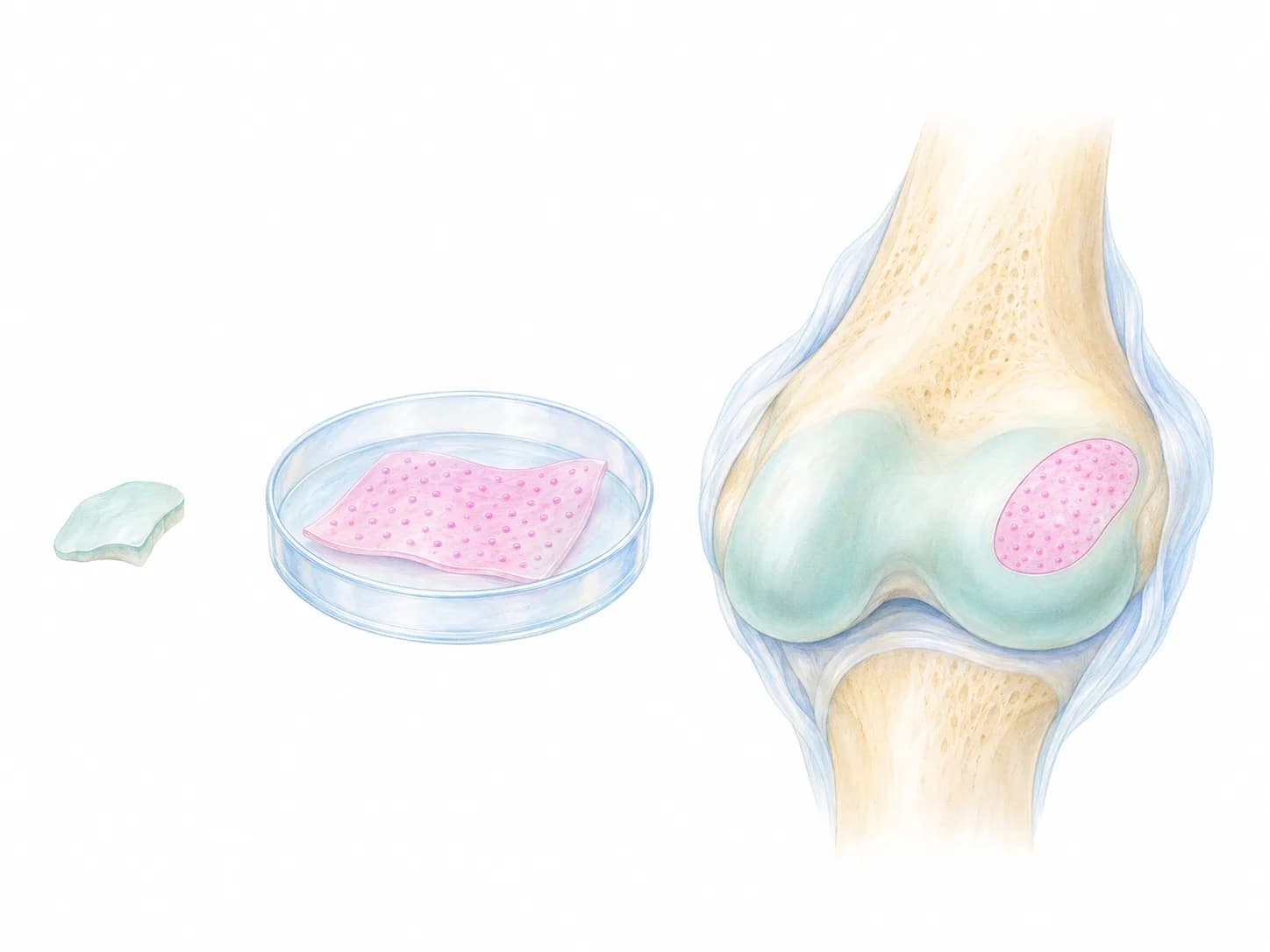
- Cartilage harvested
- Cells grown on a membrane
- Membrane implanted
MACI
Two surgeries: cartilage cells are grown on a collagen membrane in a laboratory, then the membrane is implanted.
Quick answer
ChondroFiller® is a single-stage scaffold injection; MACI is a two-stage cell-based surgical implant. MACI is recommended by NICE for selected knee cartilage defects (typically 2–10 cm²) and is delivered on the NHS for eligible patients. It involves a cartilage biopsy, four to six weeks of laboratory cell culture and a second surgery to implant the cell-loaded membrane. ChondroFiller® avoids the cell-harvest and culture step: the scaffold is placed in a single ultrasound-guided injection across the cartilage surface, with no upper age limit and no defect-size limit, and the body’s own cells migrate in to form new tissue. The right choice depends on the pattern of damage on imaging and what you want from treatment.
How it works
ChondroFiller® vs MACI: the key difference
MACI is a cell-based therapy: a small piece of the patient’s own cartilage is harvested at an arthroscopy, chondrocytes are cultured in a specialist lab for four to six weeks, and the cell-loaded collagen membrane is then implanted at a second surgery. ChondroFiller® instead delivers a sterile collagen scaffold in a single injection: there is no cell harvest, no lab culture and no second procedure. Both aim for more hyaline-like repair tissue rather than fibrocartilage, but the route to get there is very different.
How each treatment works
ChondroFiller®
ChondroFiller® is a sterile type I collagen scaffold. At London Cartilage Clinic it is injected as a liquid into the joint under ultrasound guidance, where it sets within minutes and coats the worn cartilage at the load-bearing surfaces, from a contained focal defect to diffuse surface wear.
The patient’s own cells then migrate into the scaffold and lay down new cartilage matrix over six to twelve months. Single-stage. No cell harvest. No lab phase.
MACI
MACI involves two surgical procedures. First, an arthroscopy harvests a small piece of cartilage from a non-weight-bearing area. The chondrocytes are then sent to a specialist laboratory where they are expanded onto a porcine type I/III collagen membrane over four to six weeks.
The cell-loaded membrane is then implanted into the prepared defect at a second open or mini-open surgery, secured with fibrin glue. The patient is left to mature the implant through a prescriptive rehabilitation protocol.
Looking ahead
What can you expect over time?
ChondroFiller®
Tissue formation over 6–12 months
MACI
Durable in published series at 10+ years
Read the comparison in context
Your treatment plan
Number of injections
ChondroFiller®
Typically one injection course, with the box quantity (one, two or three) decided from MRI. ChondroFiller® can be repeated for a separate new defect if needed; the originally implanted tissue is intended to be durable.
MACI
MACI is a one-off two-stage course: arthroscopic biopsy, laboratory expansion, then a second implantation surgery. A repeat MACI would require a fresh biopsy and full cell expansion again.
The treatment journeys
ChondroFiller® pathway
- 1
Consultation and MRI review
Professor Lee reviews your MRI at consultation to confirm you are suitable and to decide whether one, two or three boxes are needed. - 2
Ultrasound-guided injection
A 30 to 45 minute outpatient injection under ultrasound guidance and local anaesthetic, with the gel setting within minutes. - 3
Home the same hour
You go home within the hour with no brace or crutches unless your medical team specifies otherwise, and a free telephone review follows at six weeks.
MACI pathway
- 1
Arthroscopic biopsy
An arthroscopy harvests a small piece of cartilage from a non-weight-bearing area. - 2
Laboratory expansion
The chondrocytes are expanded onto a porcine type I/III collagen membrane in a specialist laboratory over four to six weeks. - 3
Implantation and rehabilitation
The cell-loaded membrane is implanted at a second open or mini-open surgery, secured with fibrin glue, followed by a prescriptive rehabilitation protocol.
Care and precautions
Understanding the risks
BEFORE · DURING · AFTER
Sterile technique.
Image guidance.
Clear aftercare.
These procedures sit at very different points on the invasiveness scale. ChondroFiller® at London Cartilage Clinic is an ultrasound-guided outpatient injection with routine IV antibiotic cover; the most serious risk is joint infection, which is rare.
MACI involves two surgeries, with the standard surgical risk profile: infection, deep-vein thrombosis, anaesthetic risks at each operation, plus implantation-specific concerns including graft delamination, hypertrophy and the need for a prescriptive rehabilitation programme. The cell handling and traceability is tightly regulated under UK ATMP rules.
Practical planning and safety
Questions to raise before either option
Ask about temporary soreness or swelling, the risk of joint infection, and anything specific to your health and current medicines. Ask who you contact if something does not feel right afterwards.
Who may suit ChondroFiller →Aftercare depends on the route
After the ChondroFiller injection there is no brace and no crutches unless your medical team specifies otherwise. Keyhole surgery follows the rehabilitation protocol set out by the manufacturer, with a brace for 48 hours and weight rebuilt over about six to eight weeks.
Read the injection aftercare guide →Your joint, your goals
Where does each option fit?
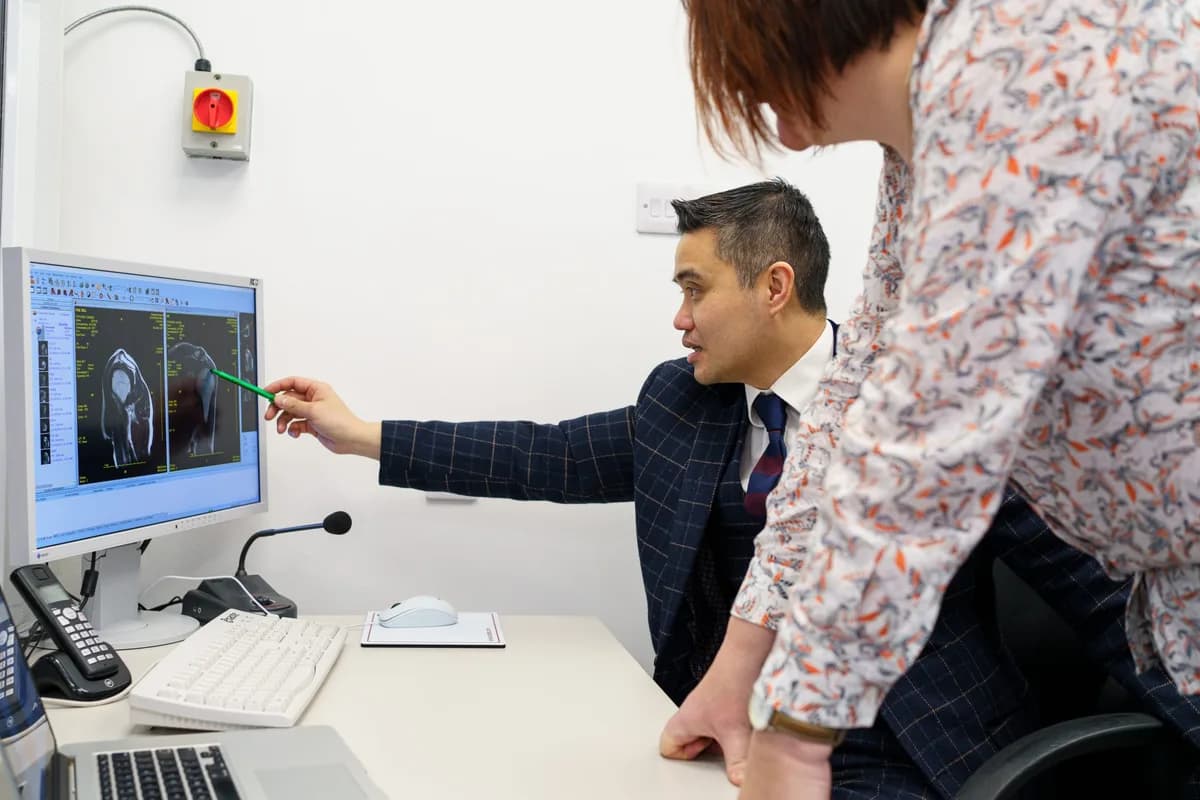
MACI is recommended for medium-to-large symptomatic knee cartilage defects in adults (typically 2–10 cm²) with otherwise reasonably preserved joints and motivated patients who can complete the rehabilitation. It is delivered through specific NHS centres for selected NICE-eligible patients, and privately at a few UK centres.
ChondroFiller® is appropriate for cartilage wear in the joint, whether a contained focal defect or diffuse surface wear, with no upper age limit and no defect-size limit on the injection. It is delivered as an injection, which suits patients who want to avoid open surgery or who are not eligible for or willing to wait for MACI. See who is suitable for ChondroFiller?
What would make the difference for you?
Questions worth taking to your consultation, so the discussion stays on your joint.
- 01What is causing my joint pain?The diagnosis and your imaging decide which treatments are worth discussing.
- 02Is there a defect, or wear across the joint?Ask how the pattern of cartilage damage shapes the recommendation.
- 03What improvement are we aiming for?Agree realistic goals for pain, function and timescale before you choose.
- 04What happens if I need more help later?Ask which options stay open if symptoms return or progress.
Planning the cost
Compare the complete care package
Ultrasound-guided injection
ChondroFiller®
From · one box
£3,000
Two boxes £5,500; three boxes £8,000. The consultation is charged separately.
Full ChondroFiller pricing →At London Cartilage Clinic, ChondroFiller® costs from £3,000 for one box, £5,500 for two and £8,000 for three, with the consultation charged separately. See the ChondroFiller® cost guide.
Private MACI typically costs £30,000 to £40,000 or more in the UK because the cell processing, laboratory expansion and two surgeries are all expensive. On the NHS, MACI is provided free for clinically eligible patients via specific commissioned centres, though access can vary by region and pathway.
For NICE-eligible patients with an NHS-available pathway, MACI is often the more efficient choice. Privately, the price gap and the single-stage nature of ChondroFiller® can make it the more accessible regenerative option for the right defect.
Making a recommendation
When each option may make sense
ChondroFiller®
A discussion to have
- A focal cartilage defect on MRI where a single-stage scaffold injection is reasonable.
- You want to avoid open surgery and the two-stage MACI pathway, where the defect size and location support a non-surgical option.
- You are private-pay and the £30k+ MACI cost is not a route you want to take when a scaffold injection is a clinically reasonable alternative.
MACI
A discussion to have
- Medium-to-large symptomatic knee cartilage defects (typically 2–10 cm²) in a motivated patient who can complete the rehabilitation.
- NICE-eligible patients with access to an NHS MACI pathway, where the procedure is funded and the surgical team has the volume.
- Cases where the surgeon judges that a cell-based, surgically implanted, scaffold is the right answer for the size and location of the defect.
Choosing another path
When another approach may be better
ChondroFiller®
A reason to reconsider
- Very large or multi-zone defects where a surgical cell-based or co-delivery procedure (MACI or Liquid Cartilage™ keyhole surgery) is more appropriate.
- Unstable subchondral bone or significant bone marrow oedema requiring a bony component to the procedure.
- Joints where imaging review points to replacement; bone-on-bone wear on its own is not the deciding factor.
MACI
A reason to reconsider
- Very small focal defects where the two-stage cell-based pathway is over-treatment.
- Patients unable to commit to the prescriptive rehabilitation programme MACI requires.
- Patients with general contraindications to open knee surgery, where a scaffold injection may be a reasonable alternative.
The bottom line
MACI is the long-established, cell-based standard for medium-to-large knee cartilage defects, and it should remain the first thought for NICE-eligible NHS patients. ChondroFiller® is a different proposition: a single-stage scaffold injection, no cell harvest, no laboratory phase, no second surgery. The right answer depends on defect size, location and what is available to you. We will tell you honestly when MACI is the better path.
Common questions
01Is ChondroFiller® a cheaper version of MACI?
They are not the same procedure. MACI is a cell-based two-stage surgical implant using the patient’s own chondrocytes cultured in a lab. ChondroFiller® is a single-stage scaffold injection that recruits the body’s own cells in situ. The price gap reflects the underlying procedure complexity, not a discounted version of the same thing.
02If MACI is available on the NHS, why would I have ChondroFiller® privately?
If you are NICE-eligible and an NHS MACI pathway is accessible, MACI is often the right first thought. People choose ChondroFiller® when MACI is not appropriate for the defect, when they cannot wait, when they want a single-stage injection over a two-stage surgery, or when their defect sits outside the MACI eligibility window.
03Can ChondroFiller® be used after MACI has failed?
Sometimes yes, where the failed MACI has left a contained defect with reasonably stable surrounding tissue, ChondroFiller® can occasionally be considered. Where the bone is irregular or the joint has progressed to broader arthritis, a different procedure may be needed. We review the post-MACI imaging before deciding.
04Does ChondroFiller® avoid the rehabilitation MACI requires?
It depends which route the gel takes. Placed by ultrasound-guided injection, ChondroFiller needs no brace and no crutches unless your medical team specifies otherwise, with about half your usual joint activity in weeks one and two and a graded return by week six; new tissue then forms over six to twelve months. Implanted arthroscopically, it follows the manufacturer’s rehabilitation (brace for 48 hours, partial weight-bearing for about six weeks). Either way it is generally less prescriptive than after MACI, because the subchondral bone has not been operated on and there is no implanted membrane to protect.
05Is the repair tissue the same?
Both procedures aim for more hyaline-like repair tissue rather than the fibrocartilage produced by marrow-stimulation techniques such as microfracture. The cellular source is different: MACI uses the patient’s own expanded chondrocytes, ChondroFiller® uses the cells that migrate into the scaffold in situ, but the goal is the same hyaline-like biology.
06How does the evidence base compare?
MACI has been on the market longer and has the longer follow-up record, including ten-year cohorts. ChondroFiller® has a younger but still substantial publication record (IKDC, Harris Hip Score, MOCART MRI), with over 19,000 cases of clinical use across joints. See the ChondroFiller® clinical evidence page.