








ChondroFiller® vs
Hyaluronic Acid
Both are clinic-delivered, ultrasound-guided injections, but they do completely different jobs. ChondroFiller® is a regenerative scaffold for a defined cartilage defect; hyaluronic acid is a joint lubricant that improves comfort for a few months. Here is the honest comparison.
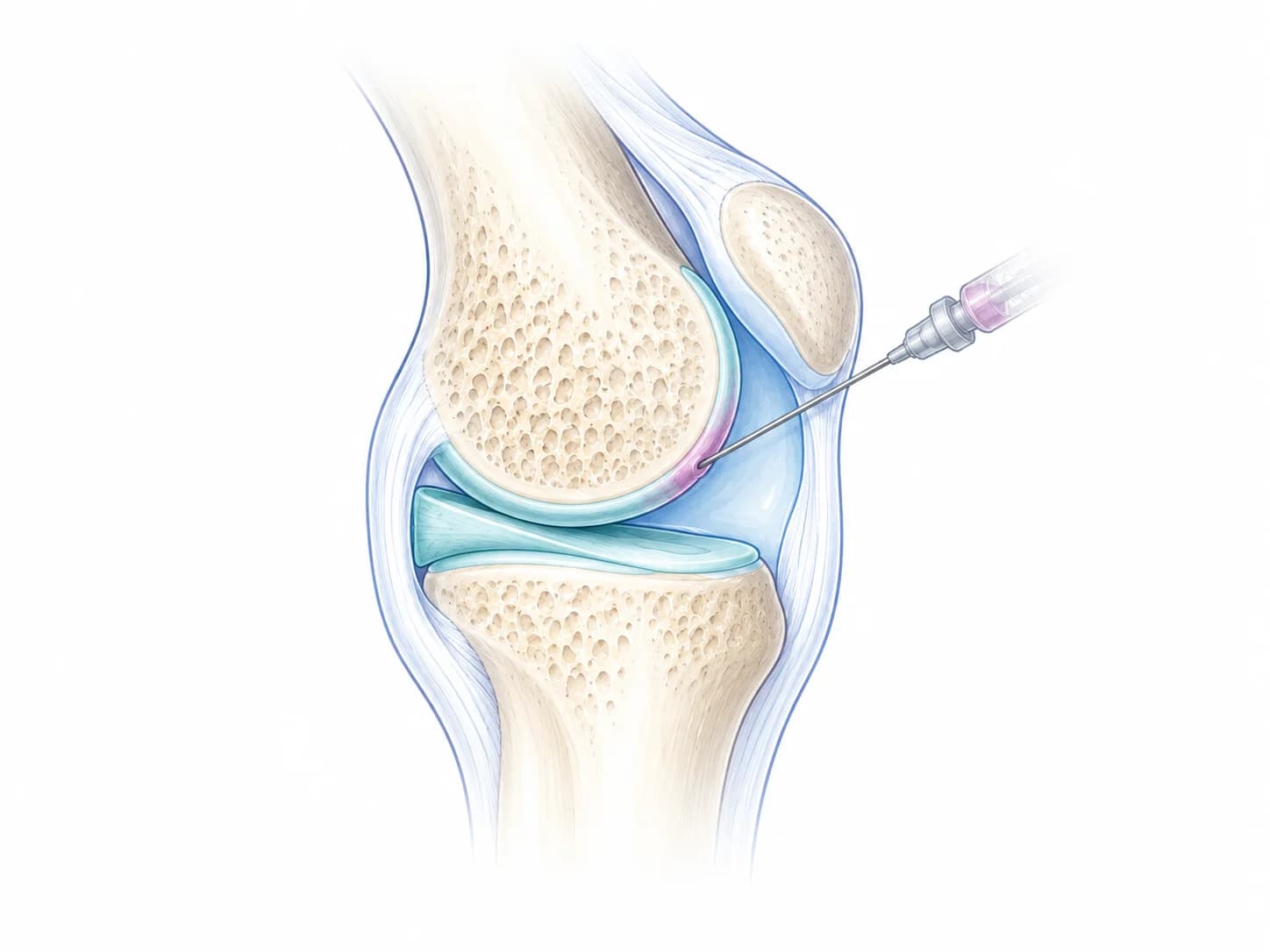
- Collagen scaffold
- Ultrasound-guided injection
- Coats the worn surface
ChondroFiller®
A collagen scaffold injected under ultrasound guidance. It sets in minutes and coats the worn cartilage so your own cells can lay down new tissue.
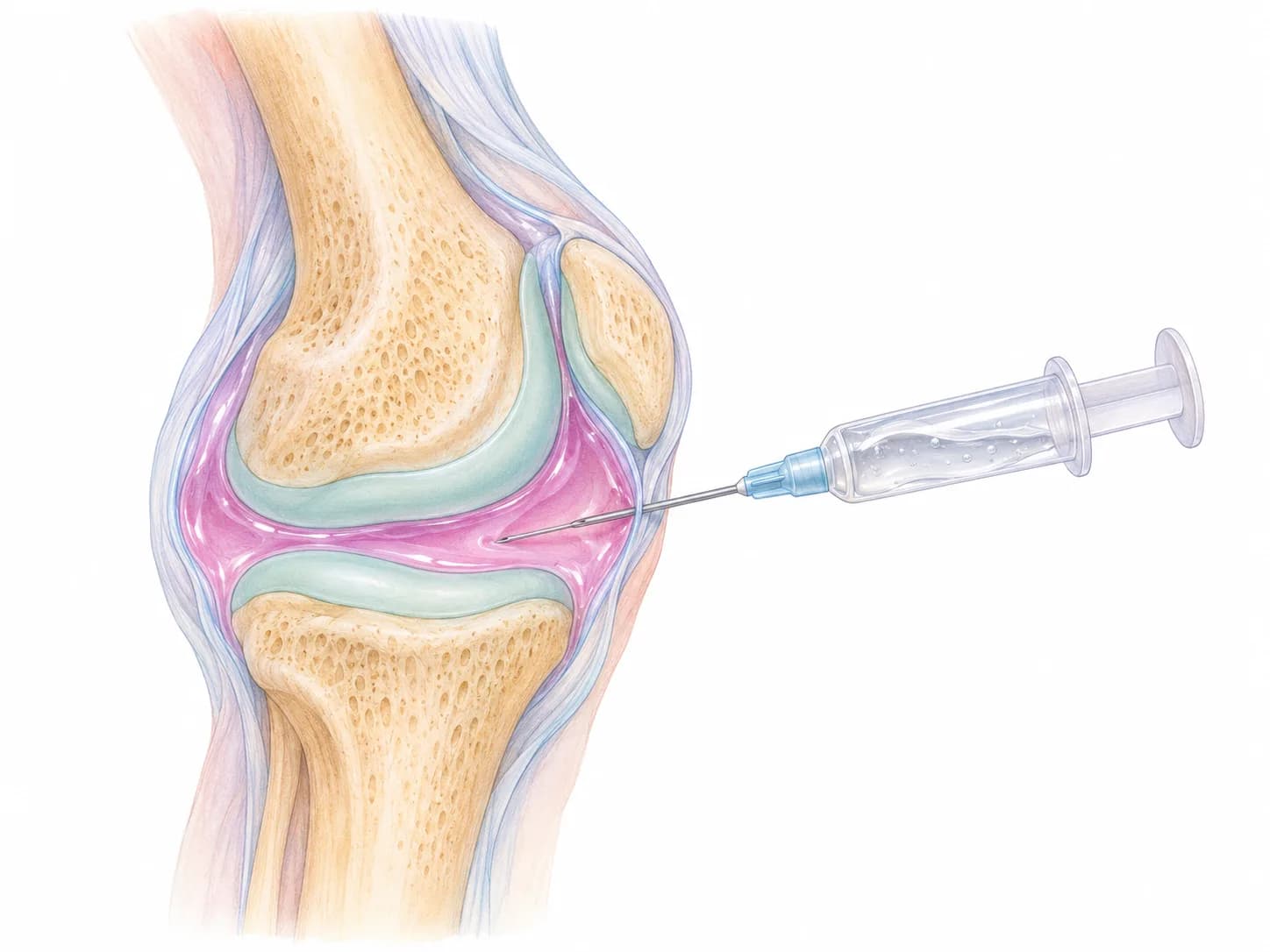
- Viscous gel
- Injected into the joint cavity
- Supplements joint fluid
Hyaluronic Acid
A gel that supplements the joint fluid, injected into the joint cavity to improve lubrication for a few months.
Quick answer
ChondroFiller® coats and restores the cartilage surface of the joint; hyaluronic acid (HA) lubricates a whole joint to reduce symptoms. HA is the most common viscosupplement in the UK (Durolane, Synvisc, Ostenil, Hyalgan and others), typically given as a single injection or a short course for mild-to-moderate knee osteoarthritis. Effects last around six months. ChondroFiller® is a different proposition entirely: a collagen scaffold delivered into the joint to coat the cartilage at the load-bearing surfaces, with no upper age limit and no defect-size limit, supporting new tissue formation over six to twelve months and maintained outcomes at five years and beyond in suitable patients. They are not interchangeable, and they are priced for different commitments.
How it works
ChondroFiller® vs Hyaluronic Acid: the key difference
Hyaluronic acid is a viscosupplement: a thick, lubricating fluid injected into the joint cavity to improve gliding and dampen pain signalling for a few months. It does not enter or fill a cartilage defect, and it is not regenerative. ChondroFiller® works the other way around: a sterile collagen scaffold is placed directly into a defined cartilage defect under ultrasound guidance, and the patient’s own cells then migrate in to lay down new cartilage matrix. Different mechanism, different target, different time horizon.
How each treatment works
ChondroFiller®
ChondroFiller® is a sterile type I collagen scaffold. At London Cartilage Clinic it is injected as a liquid into the joint under ultrasound guidance, where it sets within minutes and coats the worn cartilage at the load-bearing surfaces, from a contained focal defect to diffuse surface wear.
The patient’s own cells then migrate into the scaffold and lay down new cartilage matrix over six to twelve months. ChondroFiller® is structural and regenerative. It actually fills the defect.
Hyaluronic Acid
Hyaluronic acid is a naturally occurring component of synovial fluid. Viscosupplement injections deliver a manufactured form (or in some products a crosslinked or higher-molecular-weight form) into the joint cavity, usually under ultrasound guidance.
The gel improves the joint’s lubrication and may dampen pain signalling for a few months. HA does not regenerate cartilage, does not fill a defect and does not alter the joint surface.
Looking ahead
What can you expect over time?
ChondroFiller®
Tissue formation over 6–12 months
Hyaluronic Acid
≈ 6 months per course
Read the comparison in context
Your treatment plan
Number of injections
ChondroFiller®
Typically one injection course, with the box quantity (one, two or three) decided from MRI: one box treats most defects up to roughly 2 cm², two or three for larger or multi-zone defects. A second course is rarely needed if the original tissue establishes.
Hyaluronic Acid
HA is most often given as either a single injection (longer-acting crosslinked products such as Durolane, or single-dose protocols of other brands) or a course of three to five weekly injections. Repeat courses are commonly scheduled every six to twelve months in responders.
The treatment journeys
ChondroFiller® pathway
- 1
Imaging first
At consultation Professor Lee reads your MRI, which settles suitability and the number of boxes. - 2
Injection in clinic
The liquid scaffold is injected under ultrasound guidance and local anaesthetic in about 30 to 45 minutes, and sets within minutes. - 3
Back home and followed up
You leave the same hour, with no brace or crutches unless your medical team says otherwise, and a free telephone review follows at six weeks.
Hyaluronic Acid pathway
- 1
Injection into the joint cavity
A manufactured form of hyaluronic acid is injected into the joint cavity, usually under ultrasound guidance. - 2
A single injection or a weekly course
HA is most often given as a single injection, or as a course of three to five weekly injections. - 3
Repeat courses in responders
Relief lasts around three to six months in responders, and repeat courses are commonly scheduled every six to twelve months.
Care and precautions
Understanding the risks
BEFORE · DURING · AFTER
Sterile technique.
Image guidance.
Clear aftercare.
Both are outpatient injections with low overall complication rates. ChondroFiller® at London Cartilage Clinic is delivered under real-time ultrasound guidance with full sterile technique and routine IV antibiotic cover; the most serious risk is joint infection, which is rare.
HA is one of the most commonly delivered MSK injections in the UK with a well-documented safety profile: transient post-injection inflammation (a so-called pseudoseptic reaction) is the most reported side effect, and joint infection is rare when sterile technique is observed. Ultrasound guidance improves placement accuracy regardless of product.
Practical planning and safety
Questions to raise before either option
Ask about temporary soreness or swelling, the risk of joint infection, and anything specific to your health and current medicines. Ask who you contact if something does not feel right afterwards.
Who may suit ChondroFiller →Aftercare depends on the route
After the ChondroFiller injection there is no brace and no crutches unless your medical team specifies otherwise. Keyhole surgery follows the rehabilitation protocol set out by the manufacturer, with a brace for 48 hours and weight rebuilt over about six to eight weeks.
Read the injection aftercare guide →Your joint, your goals
Where does each option fit?

Hyaluronic acid is most defensible in mild-to-moderate knee osteoarthritis where symptom relief over a few months is the goal, particularly in patients with whole-joint symptoms rather than a single focal defect. Some patients respond well to repeat courses for several years before considering more invasive options.
ChondroFiller® works on the cartilage surface of the joint, whether the wear is a contained focal defect or diffuse across the surface. There is no upper age limit and no defect-size limit on the injection. It is a structural scaffold treatment, not a lubricant or symptom modulator. See who is suitable for ChondroFiller?
Many patients are clearly one or the other on imaging. Some sit between the two; the decision is made at consultation with imaging review, not at booking.
What would make the difference for you?
Questions worth taking to your consultation, so the discussion stays on your joint.
- 01What is causing my joint pain?The diagnosis and your imaging decide which treatments are worth discussing.
- 02Is there a defect, or wear across the joint?Ask how the pattern of cartilage damage shapes the recommendation.
- 03What improvement are we aiming for?Agree realistic goals for pain, function and timescale before you choose.
- 04What happens if I need more help later?Ask which options stay open if symptoms return or progress.
Planning the cost
Compare the complete care package
Ultrasound-guided injection
ChondroFiller®
From · one box
£3,000
Two boxes £5,500; three boxes £8,000. The consultation is charged separately.
Full ChondroFiller pricing →Injection therapy
Hyaluronic Acid
Per joint · single injection
£1,200
At London Cartilage Clinic, ChondroFiller® costs from £3,000 for one box, £5,500 for two and £8,000 for three, with the consultation charged separately. See the ChondroFiller® cost guide.
Hyaluronic acid in the UK is typically priced per injection at £200–£500, with a course of three to five injections therefore running around £600–£1,500. Single-dose crosslinked products sit at the higher end of the per-injection range. NHS funding for HA knee viscosupplementation is limited and varies by region.
The headline gap is meaningful, but the treatments are not interchangeable. Pricing should not drive the clinical decision: what the imaging shows should.
Published London Cartilage Clinic prices. Your clinical assessment confirms the appropriate treatment and plan.
Making a recommendation
When each option may make sense
ChondroFiller®
A discussion to have
- You have a focal cartilage defect on MRI with reasonably preserved surrounding tissue.
- You want a regenerative pathway that supports natural cartilage formation rather than a symptom-only modulator.
- HA has been tried previously, has helped only briefly or not at all, and the imaging now shows a focal defect.
Hyaluronic Acid
A discussion to have
- Mild-to-moderate knee osteoarthritis with whole-joint symptoms, where short-to-medium-term symptom relief is the goal.
- A patient unwilling to commit to a more invasive or higher-cost regenerative pathway, and willing to accept that HA is symptom relief rather than tissue repair.
- As a bridging option while imaging, monitoring and consultation pin down whether a structural treatment is needed.
Choosing another path
When another approach may be better
ChondroFiller®
A reason to reconsider
- Diffuse whole-joint osteoarthritis with no focal defect: a viscosupplement or another modality may be the better step.
- Active infection or unwillingness to accept the conservative safety protocol.
Hyaluronic Acid
A reason to reconsider
- A patient with a clear focal cartilage defect on MRI where a scaffold (ChondroFiller®) is the more direct regenerative step.
- Patients expecting HA to regenerate cartilage: HA is a lubricant, not a structural therapy.
- Joints where imaging review points to replacement; bone-on-bone wear on its own is not the deciding factor.
The bottom line
ChondroFiller® and hyaluronic acid look superficially similar: both are ultrasound-guided clinic injections, but they do completely different jobs. HA lubricates a whole joint for a few months; ChondroFiller® fills a focal cartilage defect and supports new tissue formation for years. The right answer comes from imaging, not from price or category. We are happy to recommend HA, no treatment, or a different pathway entirely when that is the honest answer.
Common questions
01Can I have ChondroFiller® and hyaluronic acid?
They are not usually combined in the same procedure. Where a patient has had HA already and the imaging shows a focal cartilage defect, ChondroFiller® can sometimes be the next step. The order and any combination are decided at consultation with imaging review.
02Which one regenerates cartilage?
ChondroFiller® supports natural cartilage regeneration by providing a scaffold for the body’s cells to lay down new matrix over six to twelve months. Hyaluronic acid does not regenerate cartilage; it is a viscosupplement that lubricates the joint to reduce symptoms.
03Which has more clinical evidence?
Hyaluronic acid has by far the longer publication record because it has been used in MSK practice for decades; the strength of that evidence varies by product and indication, and UK and US guideline bodies are split on whether to recommend it routinely for knee OA. ChondroFiller® has a younger but cartilage-specific outcome record (IKDC, Harris Hip Score, MOCART MRI) with over 19,000 cases of clinical use across joints. See the ChondroFiller® clinical evidence page.
04Why is ChondroFiller® so much more expensive than HA?
The two products solve different problems and have different cost bases. HA is a well-established viscosupplement injected as a course; ChondroFiller® is a sterile collagen scaffold that fills a cartilage defect and supports new tissue formation over months. The price difference reflects what each treatment is and what it aims to do, not a discounted version of the same thing.
05I have been having HA injections for years. Should I switch?
Not necessarily. If HA continues to provide useful relief and the imaging does not show a focal defect that would benefit from a scaffold, staying on HA can be a sensible plan. Where HA has stopped helping, or where the imaging now shows a defined cartilage defect, ChondroFiller® can be a reasonable next step. We review the current MRI before recommending.
06Is hyaluronic acid available on the NHS?
NHS funding for hyaluronic acid knee viscosupplementation is limited and varies by region and commissioning policy. Some pain clinics and integrated MSK services offer it within structured pathways; others do not. ChondroFiller® is not routinely funded by the NHS in the UK and is a private treatment at this time.