








ChondroFiller® Injection vs
Liquid Cartilage™
ChondroFiller® injection and Liquid Cartilage™ are two distinct procedures invented by Professor Paul Lee, both aimed at preserving and restoring your own cartilage rather than replacing the joint. The injection coats the cartilage surface across the whole joint; Liquid Cartilage™ is a keyhole surgical procedure that regenerates native cartilage at a contained area of damage. Here is what each does, and how we decide which one fits.
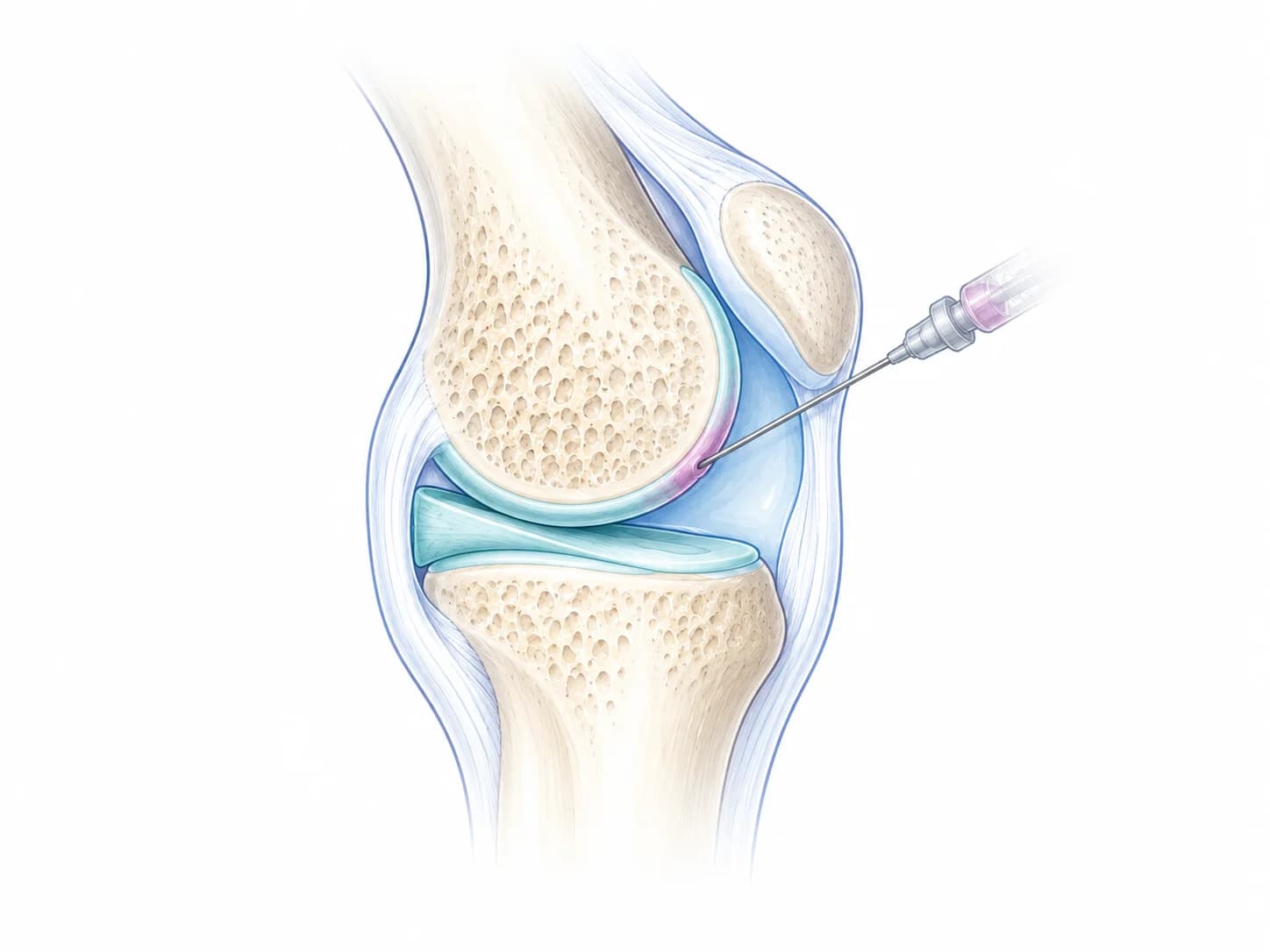
- Collagen scaffold
- Ultrasound-guided injection
- Coats the worn surface
ChondroFiller® Injection
A collagen scaffold injected under ultrasound guidance. It sets in minutes and coats the worn cartilage so your own cells can lay down new tissue.
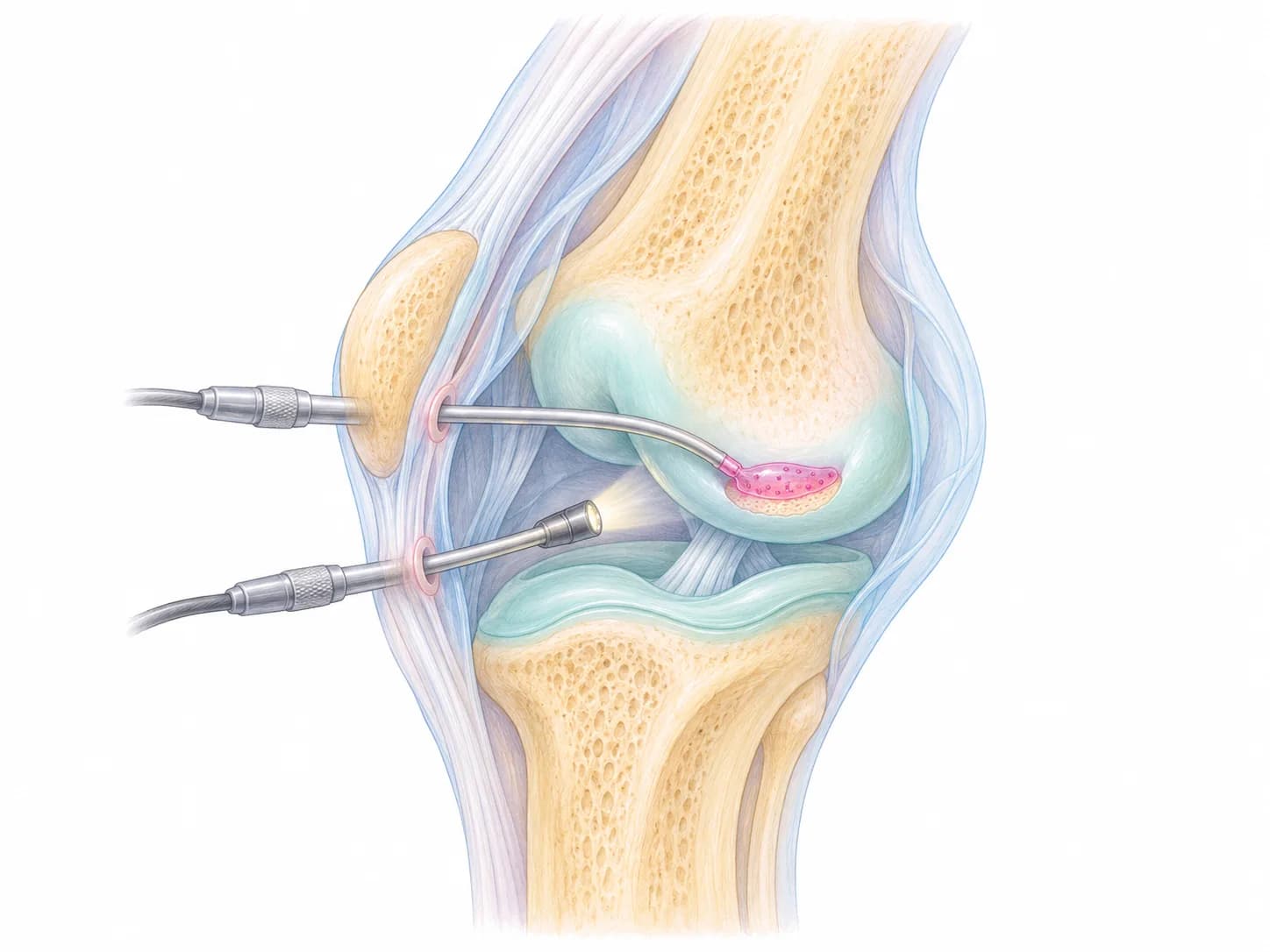
- Keyhole access
- Defect prepared
- Scaffold with your own cells
Liquid Cartilage™
A keyhole day-case procedure that delivers the ChondroFiller scaffold with your own cells into a prepared defect.
Quick answer
ChondroFiller® injection restores the cartilage surface across the whole joint in a single delivery, with no upper age limit and no defect-size limit. Liquid Cartilage™ is a keyhole surgical procedure that regenerates native cartilage at a contained area of damage and depends on the body’s capacity to grow new tissue. Both are private-pay procedures invented by Professor Paul Lee. The injection is an outpatient appointment from £3,000; Liquid Cartilage™ is a day-case keyhole procedure under general anaesthetic at a flat £9,800. Which one fits depends on the pattern of wear on your MRI and, for the surgical pathway, on your body’s regenerative capacity, which is assessed individually at consultation.
How it works
ChondroFiller® Injection vs Liquid Cartilage™: the key difference
ChondroFiller® injection works on the whole cartilage surface of the joint. The collagen scaffold is delivered into the joint under ultrasound guidance and sets in place, coating the cartilage at the load-bearing bone surfaces in a single delivery. Because the procedure does the protective work itself and does not require the body to grow large amounts of new cartilage to be effective, it has no upper age limit and no defect-size limit.
Liquid Cartilage™ is a surgical regeneration procedure. Through a single keyhole operation, the damaged cartilage at a contained area is excavated and a scaffold with cellular co-delivery is placed at that site, so that new native cartilage regrows there over the following months. Because Liquid Cartilage™ is a regenerative procedure, it depends on the body still having the capacity to grow new tissue. Suitability is not really a question of chronological age (years lived), but of biological age: how well your body’s repair and regenerative systems are still working. A patient in their 60s in strong general health can regenerate cartilage better than a less-well patient in their 40s. The frequently-cited 55-year guideline in the literature is a starting point, not a cut-off, and is assessed individually at consultation.
Professor Lee often explains the distinction to patients this way. ChondroFiller® injection is like resurfacing a road where the entire surface is worn but the structure underneath is intact: a fresh protective layer is laid across the whole stretch in a single pass. Liquid Cartilage™ is like regenerating a specific damaged section of road where the road is sound overall but one area is broken through: that area is excavated and rebuilt so the surface regrows. Both are real, lasting interventions; each fits a different starting condition.
How each treatment works
ChondroFiller® Injection
ChondroFiller® injection is delivered in a 30 to 45 minute outpatient appointment under local anaesthetic and ultrasound guidance. The two-part collagen scaffold is mixed in the syringe at the moment of injection and delivered into the joint, where it sets in place over a few minutes and coats the cartilage at the load-bearing bone surfaces.
The patient’s own cells then migrate into the scaffold and lay down new cartilage matrix over the following six to twelve months. No general anaesthetic, no incision, no theatre time.
Liquid Cartilage™
Liquid Cartilage™ is a keyhole (arthroscopic) day-case procedure performed under general anaesthetic. Professor Lee maps the area of cartilage damage, excavates the damaged cartilage at that site, and delivers the ChondroFiller® scaffold together with medicinal signalling cells (MSCs) into the prepared area.
New native cartilage then regenerates at that site over six to twelve months, integrated with the surrounding tissue. The procedure takes place at our Weymouth Street surgical venue and the patient goes home the same day. Recovery then follows the manufacturer’s rehabilitation: a brace or splint for 48 hours, then partial weight-bearing for about six weeks.
Looking ahead
What can you expect over time?
ChondroFiller® Injection
Tissue formation over 6–12 months
Liquid Cartilage™
Native cartilage regrows over 6–12 months
Read the comparison in context
Your treatment plan
Number of injections
ChondroFiller® Injection
Typically one injection course, with the box quantity (one, two or three) decided from MRI: one box for most cases, two or three where larger surface area or multiple zones need coverage. A separate future course can be considered if needed.
Liquid Cartilage™
Liquid Cartilage™ is a single surgical procedure, not a course of injections. The procedure is done once and the regenerated cartilage establishes over the months that follow.
The treatment journeys
ChondroFiller® Injection pathway
- 1
Review with Professor Lee
Your MRI and examination are reviewed to decide whether the injection suits you and how many boxes are needed. - 2
Injection under ultrasound
A 30 to 45 minute outpatient appointment under local anaesthetic, with no incision and the gel setting within minutes. - 3
Straight home, no brace
You go home the same hour without a brace or crutches unless your medical team specifies otherwise, with a free telephone review at six weeks.
Liquid Cartilage™ pathway
- 1
Imaging review and consultation
Professor Lee maps the area of cartilage damage and assesses your regenerative capacity at consultation. - 2
Day-case keyhole surgery
Under general anaesthetic, the damaged cartilage is excavated and the ChondroFiller® scaffold is delivered with MSCs, and you go home the same day. - 3
Manufacturer rehabilitation
Recovery follows the manufacturer’s rehabilitation: a brace or splint for 48 hours, then partial weight-bearing for about six weeks.
Care and precautions
Understanding the risks
BEFORE · DURING · AFTER
Sterile technique.
Image guidance.
Clear aftercare.
ChondroFiller® injection is a low-risk outpatient procedure. The most serious risk is joint infection, which is rare; we use real-time ultrasound guidance, full sterile technique and routine IV antibiotic cover as an added safety layer.
Liquid Cartilage™ is keyhole day-case surgery under general anaesthetic, with the standard considerations that come with any arthroscopy: anaesthetic risk, joint infection risk (very low under the protocols used), post-operative swelling and a staged return to activity: partial weight-bearing for about six weeks and high-load sport from six months. The Weymouth Street surgical venue and the full anaesthetic team are part of the flat-fee structure.
Practical planning and safety
Questions to raise before either option
Ask about temporary soreness or swelling, the risk of joint infection, and anything specific to your health and current medicines. Ask who you contact if something does not feel right afterwards.
Who may suit ChondroFiller →Aftercare depends on the route
After the ChondroFiller injection there is no brace and no crutches unless your medical team specifies otherwise. Keyhole surgery follows the rehabilitation protocol set out by the manufacturer, with a brace for 48 hours and weight rebuilt over about six to eight weeks.
Read the injection aftercare guide →Your joint, your goals
Where does each option fit?

ChondroFiller® injection is appropriate for cartilage wear in the knee, hip, shoulder, ankle, elbow, foot, hand or wrist, whether the wear is a contained focal area or diffuse across the joint surface. There is no upper age limit and no defect-size limit on the injection. It is particularly valuable as a pre-replacement option for active patients in their 60s, 70s and beyond who want to preserve their own joint. See who is suitable for ChondroFiller®?
Liquid Cartilage™ is appropriate where the pattern of damage on imaging is a contained area of cartilage damage in an otherwise healthy joint, and where the patient still has the biological capacity for new cartilage to regenerate. Chronological age (years lived) is not the deciding factor; biological age (how well your tissues still repair and regenerate) is. The 55-year guideline in the literature is a starting point, not a cut-off, and is assessed individually at consultation. See the Liquid Cartilage™ procedure page.
What would make the difference for you?
Questions worth taking to your consultation, so the discussion stays on your joint.
- 01What is causing my joint pain?The diagnosis and your imaging decide which treatments are worth discussing.
- 02Is there a defect, or wear across the joint?Ask how the pattern of cartilage damage shapes the recommendation.
- 03What improvement are we aiming for?Agree realistic goals for pain, function and timescale before you choose.
- 04What happens if I need more help later?Ask which options stay open if symptoms return or progress.
Planning the cost
Compare the complete care package
Ultrasound-guided injection
ChondroFiller® Injection
From · one box
£3,000
Two boxes £5,500; three boxes £8,000. The consultation is charged separately.
Full ChondroFiller pricing →Liquid Cartilage™
Liquid Cartilage™
Flat fee
£9,800
ChondroFiller® injection at London Cartilage Clinic costs from £3,000 for one box, £5,500 for two and £8,000 for three, including (ultrasound, the ChondroFiller® product, the injection and a six-week clinical follow-up). The consultation is charged separately. See the ChondroFiller® cost guide.
Liquid Cartilage™ is a flat £9,800 covering the surgeon, theatre, consultant anaesthetist, the ChondroFiller® scaffold, the MSC co-delivery component and the post-operative follow-up programme. Because it is a single-stage surgical procedure with no laboratory phase and no second operation, it is meaningfully less than two-stage cell-based cartilage repair pathways such as MACI.
The right comparison is which procedure fits the pattern of damage on imaging, not the headline price.
Published London Cartilage Clinic prices. Your clinical assessment confirms the appropriate treatment and plan.
Making a recommendation
When each option may make sense
ChondroFiller® Injection
A discussion to have
- Cartilage wear in the joint, whether a contained focal area or diffuse across the surface.
- Patients of any age, including active patients in their 60s, 70s and beyond.
- A pre-replacement option for patients who have been told they need a joint replacement but want to try joint preservation first.
- Patients who want to avoid surgery and a general anaesthetic.
Liquid Cartilage™
A discussion to have
- A contained area of cartilage damage on MRI in an otherwise healthy joint, with strong biological capacity to regenerate.
- Patients seeking regenerated native cartilage at the treated site, rather than a protective coating across the joint surface.
- Patients prepared to accept a day-case surgical procedure under general anaesthetic in exchange for the regenerative result.
Choosing another path
When another approach may be better
ChondroFiller® Injection
A reason to reconsider
- A single contained area of cartilage damage in an otherwise healthy joint with strong biological capacity to regenerate, where Liquid Cartilage™ may be the more targeted intervention.
- Untreated joint instability or major malalignment, where the mechanical problem needs to be addressed first.
Liquid Cartilage™
A reason to reconsider
- Diffuse surface wear across the joint, where the injection is the better fit.
- Patients whose biological age and overall regenerative capacity make new cartilage regrowth unlikely; the injection is often the more appropriate intervention in this setting.
- Patients who decline surgery or general anaesthetic, where the injection is the alternative regardless of damage pattern.
The bottom line
ChondroFiller® injection and Liquid Cartilage™ are two distinct procedures invented by Professor Paul Lee, each appropriate for a different pattern of cartilage damage and different patient needs. The injection restores the cartilage surface across the whole joint with no age or size limit. Liquid Cartilage™ regenerates native cartilage at a contained area through a single keyhole surgical procedure, in patients whose biological capacity supports regeneration. The right answer comes from imaging review and an honest conversation about your goals and your regenerative capacity, not from a default label.
Common questions
01Are ChondroFiller® injection and Liquid Cartilage™ the same procedure?
No. They share the ChondroFiller® collagen scaffold material, but the procedures are fundamentally different. ChondroFiller® injection is a non-surgical, ultrasound-guided outpatient injection that coats the cartilage surface across the whole joint. Liquid Cartilage™ is a keyhole surgical procedure that excavates damaged cartilage at a contained area, delivers the ChondroFiller® scaffold plus MSC co-delivery, and regenerates new native cartilage at that site. Different delivery, different mechanism, different indication.
02How do you decide which one is right for me?
Imaging review and a consultation. The pattern of cartilage wear on your MRI is the biggest single input: diffuse wear across the joint surface tends to fit the injection; a contained area of damage in an otherwise healthy joint tends to fit Liquid Cartilage™. Your biological age (not just years lived), your goals, your tolerance for a surgical procedure and your willingness to wait through a regenerative timeline all feed into the recommendation.
03I am over 55, can I still have Liquid Cartilage™?
Possibly. The 55-year guideline cited in the literature is exactly that, a guideline. Liquid Cartilage™ depends on the body’s biological capacity to regenerate new cartilage, which is governed by overall health and the condition of your tissues, not just the number of years lived. Many patients above 55 in strong health regenerate well; some below 55 in poorer health do not. Suitability is assessed individually at consultation. If Liquid Cartilage™ is not the right fit, the ChondroFiller® injection is available regardless of age and is often the better answer in this situation.
04Do I have to choose between them, or could I have one and then the other?
They are usually offered as alternative pathways for the same joint, not as sequential treatments in immediate succession. Patients who have had ChondroFiller® injection earlier and later develop a specific contained area of damage can in principle be considered for Liquid Cartilage™ at that site, and the reverse can also be considered. The decision is always made at consultation with current imaging.
05Why is the injection an outpatient appointment but Liquid Cartilage™ is a surgical procedure?
The two procedures do different things. The injection coats the cartilage surface across the whole joint, which can be delivered under ultrasound guidance in an outpatient appointment. Liquid Cartilage™ excavates the damaged cartilage at a contained area so that new native cartilage can regenerate there, which requires arthroscopic access under general anaesthetic. The different setting reflects what the procedure is actually doing.